Install Wonderland Engine
Installer (Windows)
Download the Windows installer from downloads.
SmartScreen
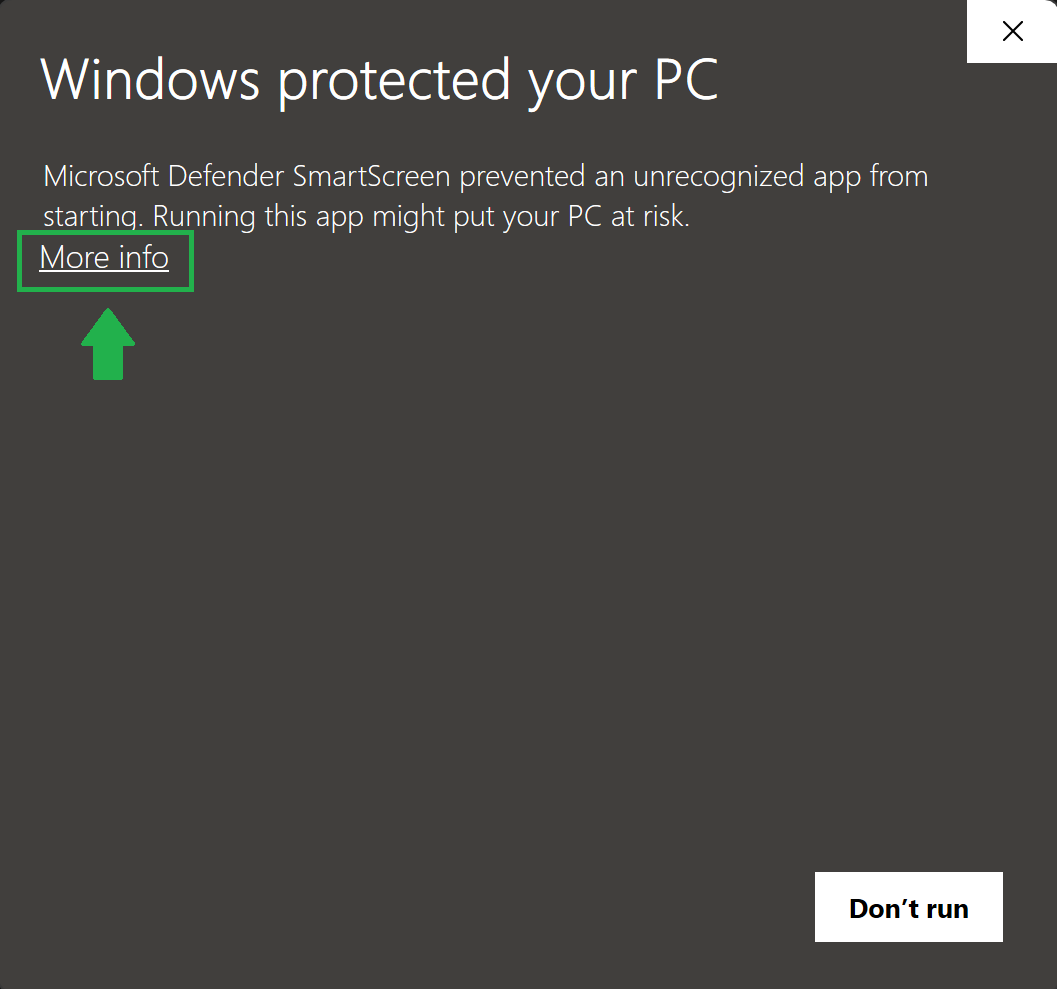
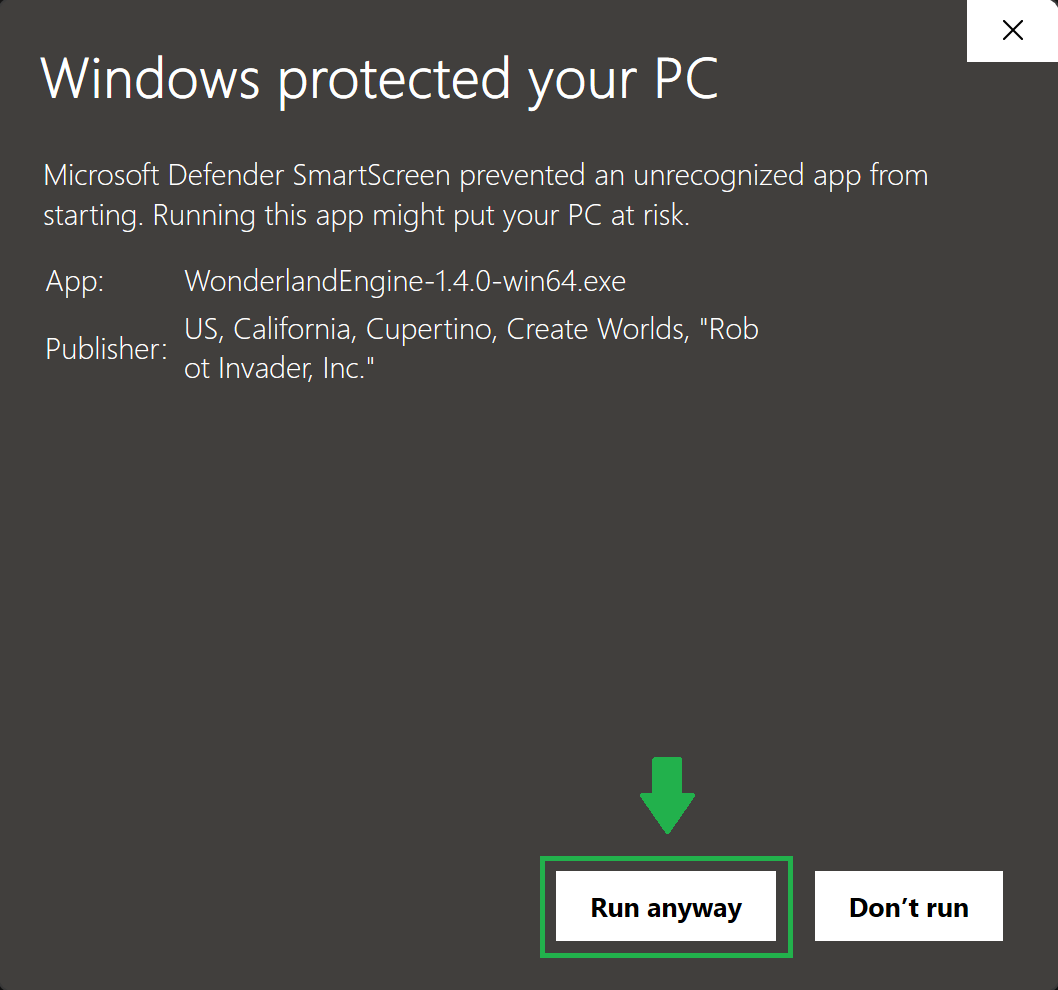
If you see a screen like the following after starting the installer, click “More info” and “Run anyway” to proceed with the installation.
Troubleshooting
If the application does not start, it might be choosing invalid default energy settings and you need to manually select one:
- “Settings > Graphics settings”
- Choose Wonderland Engine or find it in its default path
C:\Program Files\Wonderland\WonderlandEngine\bin\WonderlandEditor.exe - Choose anything but “System default” (“High peformance” is recommended).
Drag and Drop (MacOS)
Download the Drag and Drop (*.dmg) installer from downloads.
Double-click the installer and then drag “Wonderland Editor” into “Applications”.
Flatpak (Linux)
Wonderland Engine is available on FlatHub as a flatpak.
Either install through the FlatHub software manager, or, to install from the terminal, run the following commands:
flatpak install flathub com.wonderlandengine.editor
flatpak run com.wonderlandengine.editor
Troubleshooting
If the editor crashes on startup with an NVIDIA GPU, for example with a segmentation fault right after “Initializing Plugin: PluginsView” and no window or only a black window, disable NVIDIA’s threaded OpenGL optimizations:
flatpak override --user --env=__GL_THREADED_OPTIMIZATIONS=0 com.wonderlandengine.editorIf you are not using the flatpak, set __GL_THREADED_OPTIMIZATIONS=0 in the environment
before starting WonderlandEditor. To undo the flatpak override, run
flatpak override --user --reset com.wonderlandengine.editor.
If --windowless crashes with a segmentation fault (exit code 139) after printing
“Running in windowless mode”, the editor could not open an X11 display. Windowless mode still
needs one, so make sure DISPLAY points to a running X server. On Wayland desktops this is
Xwayland. On machines without a desktop, such as CI runners or servers, use a virtual display:
xvfb-run -a WonderlandEditor --windowless --project MyProject.wlp --packageIf you see “GLFW: X11: Failed to open display :1” on Wayland, the Xwayland socket is
missing, for example because a /tmp cleanup removed /tmp/.X11-unix/X1. Log out and back in
to recreate it. This also fixes the windowless crash above.
If windowless mode reports “You need to log in to use WonderlandEditor.”, sign in once in
the editor window, or pass credentials with --credentials, either as an API-Token or as
email:password. You can also set the WLE_CREDENTIALS environment variable to an API-Token,
which you can retrieve in the account page, under “API-Token”. Keep the token in a
file only you can read (chmod 600) rather than typing it on the command line, where it ends up
in your shell history.
If the bundled npm fails with “Cannot find module …/node_modules/npm/index.js” in the flatpak, point it to the npm that ships with the editor:
flatpak run --env=NPM_CLI_JS=/app/share/wonderlandengine/npm/index.js \
  --command=npm com.wonderlandengine.editor install
If there is no launcher entry after installing, and you just installed Flatpak itself, log
out and back in. Flatpak adds its application folder to your desktop’s search path at login.
Until then, start the editor with flatpak run com.wonderlandengine.editor.
To stop an editor running in windowless mode, run
flatpak kill com.wonderlandengine.editor. The process is named Main, so pkill and pgrep
do not find it by the editor’s name.